Double Rod Cylinder Structure, Benefit, Application
Have you ever wondered why some machines move so smoothly in both directions?
That’s the magic of a double rod cylinder. This type of pneumatic cylinder is designed with two piston rods — one on each side. That means balanced force, better stability, and precise movement. No wobbling. No guessing. Just reliable motion.
In this guide, we’ll explore everything you need to know about double rod pneumatic cylinders.
We’ll answer important questions like:
- What is a double rod cylinder?
- Where is it used in automation?
- Should you choose double rod or single rod?
- How can you avoid common problems like bending and leakage?
If you’re planning a project that needs accurate and strong push-pull motion, this article will help you make the right choice.
And yes — if you ever need a quote for OEM or custom double rod cylinders, feel free to contact us anytime. We’re here to help.
✅ What Is a Double Rod Cylinder?
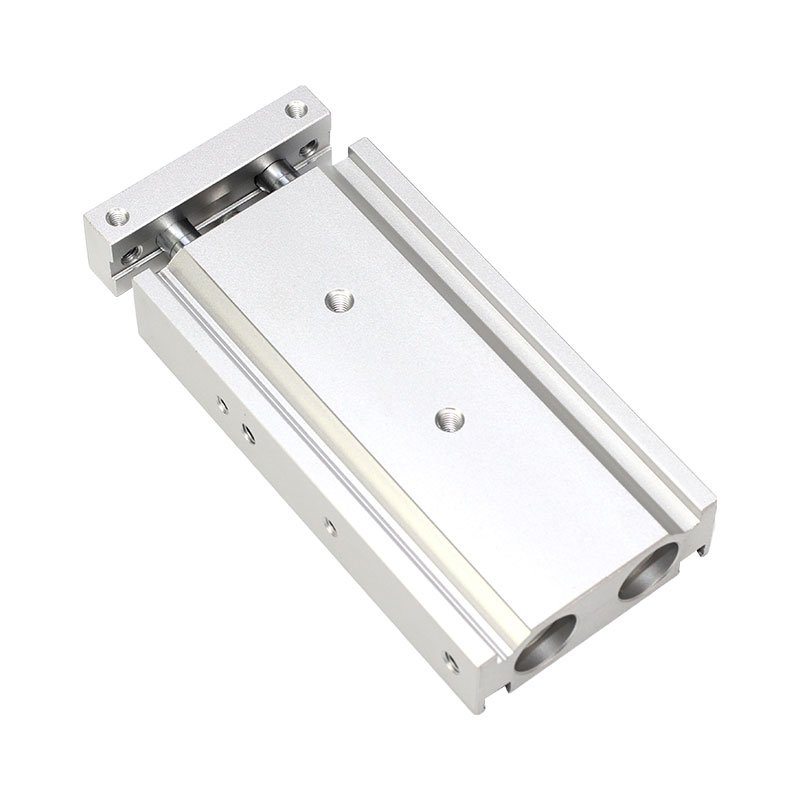
A double rod cylinder is a pneumatic actuator where the piston is connected to two rods. These rods extend out from both ends of the cylinder body. This creates equal thrust in both directions.
Here’s a simple comparison:
| Feature | Double Rod Cylinder | Single Rod Cylinder |
|---|---|---|
| Piston Rod | Two rods | One rod |
| Output Force | Balanced on extension & retraction | Stronger on one direction |
| Stability | Very strong | Medium |
| Anti-rotation | Naturally supported | Needs additional design |
| Best Use Case | Precise movement & balanced load | General motion tasks |
Why does this matter?
Because in automation, precision and stability often mean higher productivity and longer machine life.
The core value of a double rod pneumatic cylinder lies in how it handles force and motion. In a single rod cylinder, one side has less surface area because the rod takes up space. That means the pushing force differs from the pulling force. And in some machines, this imbalance creates vibration, speed changes, and even misalignment.
A double rod cylinder fixes that problem by using two identical rods, so both sides of the piston have the same surface area. As a result:
- The cylinder moves evenly in both directions
- Load can be applied on both ends with confidence
- Motion is smoother, even at high speeds
- Position accuracy remains stable over long cycles
Another bonus?
The second rod can also serve as a position reference. Since both rods stay aligned, the system is naturally anti-rotation, which is helpful for devices like clamping tools, sliders, pick-and-place arms, and indexing stations.
So if you’re building a machine and don’t want twisting, drifting, or unpredictable motion, this kind of cylinder may be exactly what you need.
👉 Need technical drawings or data sheets? Send us your project details — we reply fast!
✅ Double Rod Cylinder Structure & How It Works
Let’s break things down simply:
| Component | Role |
|---|---|
| Cylinder barrel | Houses piston & rod movement |
| Piston | Converts air pressure into motion |
| Two piston rods | Output force in both directions |
| Seals | Prevent leakage |
| End caps | Support & guide motion |
| Optional guide device | Adds extra stability |
Pressurized air enters either end of the cylinder → pushes the piston → both rods move together.
The working principle looks simple, but the engineering behind it matters, especially when machines operate 24/7. When air fills one chamber inside the barrel, the piston is forced to move, pushing both rods outward. When air pressure switches to the other side, the rods retract with the exact same force.
This balance creates a perfect push-pull system. For example:
- A robot arm placing components on a conveyor
- A sliding table pushing items into a packaging machine
- Material carriers moving in both directions with equal load
Because the rods are symmetrical, they distribute load more evenly. This prevents side-load bending, a common failure issue in single-rod cylinders.
Also, manufacturers can add guide rods, linear bearings, or non-rotating structures to achieve:
- Higher rigidity
- Longer stroke options
- Smoother sliding action
- Accuracy over repeated cycles
If your system uses sensors and positioning valves, a double rod cylinder works extremely well with feedback control systems, meaning more automation and better product quality.
👉 We can help you choose the right structure based on your load and speed — just let us know what you need!
✅ Main Advantages of Double Rod Cylinders
| Advantage | Benefit |
|---|---|
| Balanced force | Equal power in both directions |
| High rigidity | Strong against bending and side loads |
| Better positioning | High repeatability |
| Anti-rotation function | No twisting of the load |
| Stable & fast motion | Perfect for automation |
Now let’s talk real-world benefits. When you choose a double rod actuator, you’re investing in reliability. Machines don’t like surprises — vibration, misalignment, and play (looseness) in the motion system can lead to breakdowns. This cylinder design minimizes all of that.
For industries like automotive assembly, semiconductor handling, or precision packaging, the last thing you want is:
- Products misaligned
- Clamps not meeting perfectly
- Equipment wearing down faster
Double rod cylinders simply perform better here. They support heavy or uneven loads without twisting. They maintain straight-line movement even when the environment forces extra stress onto the rod. And because the force output is balanced, control valves and programming become easier.
Another major advantage is speed. Because both sides provide the same resistance, the piston accelerates more smoothly, giving consistent cycle times. This is vital for mass production.
Plus, maintenance teams love them — fewer issues mean less downtime.
👉 Want higher durability and fewer replacement parts? A double rod cylinder might be your best decision.
✅ Possible Drawbacks & What to Watch Out For
| Limitation | Impact |
|---|---|
| Larger installation space | Needs more room in equipment |
| Higher cost than single rod | More material & seals |
| Requires good alignment | Avoids rod deviation |
| Double sealing points | More sealing maintenance |
Even the best designs have trade-offs. A double rod pneumatic cylinder uses two rods, so naturally it requires more installation length. If your space is extremely tight, you may need to reconsider layout or choose a guided single-rod design.
Cost is another factor. Because there are two rod seals, two precision-ground shafts, and extra support structures, the initial price is higher. But when considering lifecycle cost, the equipment usually lasts longer — especially under side-load conditions.
Alignment is critical. If the rods are pushed sideways, seals can fail early. However, a proper mounting structure eliminates this risk. We always suggest:
- Check load direction
- Use external guides when needed
- Confirm stroke & support points before installation
As long as your design is correct, these cylinders deliver excellent long-term performance.
👉 If cost and space concern you, we provide professional engineering advice to help you choose smart.
✅ Where Are Double Rod Cylinders Used?
| Industry | Use Case |
|---|---|
| Automation | Push-pull sliders, index tables |
| Electronics | Precision positioning |
| Packaging | Sealing and cutting operations |
| Automotive | Clamping and welding fixtures |
| Material Handling | Lift and transfer devices |
Anytime you need controlled movement in both directions, a double rod cylinder shines. Think about a production line: products must move from station to station repeatedly. A mechanism may need to push an item forward, then pull back to start again. With equal strength and movement, there’s less risk of jamming or shifting.
Robotic systems also appreciate the non-rotation feature, which ensures that grippers meet objects correctly every time. In packaging, high-speed knives and sealing heads rely on balanced power to prevent tearing or uneven cuts.
Even in heavy industries, a double rod cylinder handles stress like a champion. It doesn’t twist under side load, which keeps welded frames and clamping systems perfectly aligned.
If your equipment works with positioning accuracy or frequent motion cycles, picking this type of cylinder can greatly extend machine life and improve product quality.
👉 Tell us your application — we can suggest the best model and accessories!
✅ How to Select the Right Double Rod Cylinder
Here’s a quick checklist:
| Selection Factor | Why It Matters |
|---|---|
| Bore size | Determines power |
| Stroke length | Affects motion range |
| Rod diameter | Controls load strength |
| Mounting style | Ensures stability |
| Working environment | Temperature & dust |
| Speed & frequency | Impacts lifecycle |
Choosing the right double rod air cylinder isn’t only about size. You must consider motion physics, load distribution, and operating speed. For example:
✅ Heavy loads → Larger bore + thicker rod
✅ High accuracy → Anti-rotation design + precise guides
✅ High speed → Proper cushioning + lubrication
✅ Dirty environment → Dust-proof seals
✅ High frequency → Strong wear-resistant materials
Don’t forget side loads. If the cylinder alone carries all the weight and direction forces, the rod may bend. Use guide rails or a support structure whenever possible.
A detailed consultation with your supplier helps avoid future headaches.
We provide:
- Custom stroke machining
- Different mounting brackets
- Rod thread options
- Special seals for moisture, heat, or chemicals
👉 Share your load weight + required stroke + speed and we’ll prepare a fast quote for you.
✅ Double Rod vs Single Rod Cylinder
| Feature | Double Rod | Single Rod |
|---|---|---|
| Motion Precision | ⭐⭐⭐⭐⭐ | ⭐⭐⭐ |
| Load Stability | High | Medium |
| Anti-rotation | Built-in | Optional |
| Price | Higher | Lower |
| Space Requirement | Larger | Smaller |
If your machine needs accuracy and balanced force, the double rod design is the winner.
A double rod cylinder is small but powerful.
It keeps machines steady, accurate, and reliable — even under tough working conditions. When equipment needs balanced push-pull force, no twisting, and long-term precision, this type of pneumatic cylinder is a smart choice.
Whether you’re upgrading old machinery or building a brand-new automation project, selecting the right cylinder will save you time, energy, and repair costs later. And if you need professional advice — just ask!
📩 Contact us today for OEM double rod pneumatic cylinders
Let’s make your automation smarter and more efficient!