In any compressed air system, planning air filter element replacement at the right time is one of the simplest ways to protect valves, cylinders and tools while controlling energy costs. When an air filter element replacement is delayed, pressure drop and contamination increase silently until production quality, machine uptime and compressor efficiency all start to suffer. This guide explains what determines air filter element lifespan, how to recognize replacement indicators, and how to set a maintenance strategy for FRL units that balances cost with reliability.
TABLE OF CONTENTS
- Understanding Air Filter Element Lifespan
- What an Air Filter Element Does
- Factors That Shorten Service Life
- Key Indicators It Is Time for Air Filter Element Replacement
- Pressure Drop and Energy Waste
- Visual Inspection and Contamination Signs
- Recommended Air Filter Element Replacement Intervals
- Time-Based Maintenance Intervals
- Condition-Based Replacement Strategy
- How to Replace Air Filter Elements Safely in FRL Units
- Preparation and Isolation Steps
- Replacement Procedure and Re-Start Checks
- Best Practices to Maximize Air Filter Element Lifespan
- Choosing the Right Filter Type and Micron Rating
- Integrating Filters into Preventive Maintenance Programs
- FAQ: Air Filter Element Replacement
Understanding Air Filter Element Lifespan
What an Air Filter Element Does
In a typical FRL unit, the air filter element is the first line of defense between the compressor and your pneumatic equipment. It traps solid particles such as rust, scale and dust, and in many designs it also helps separate liquid water and oil aerosols from the air stream. As contamination builds up in the pores of the media, the element gradually becomes more restrictive, which is why air filter element replacement is a recurring requirement rather than a one-time installation.
Most industrial FRL filters use replaceable elements made from sintered bronze, non-woven synthetic fibers or pleated media. These are optimized to stop particles down to a given micron rating (for example 5 μm or 40 μm) while keeping pressure drop as low as practical. Over time, the combination of trapped dirt, oil, and condensed moisture slowly fills the void spaces in the media until further airflow requires more and more differential pressure to pass through.
Factors That Shorten Service Life
Air filter element lifespan is not fixed; it depends strongly on how harsh the operating environment is and how the compressor and upstream air treatment are managed. The main factors that shorten service life include:
- Ambient air quality at the compressor intake:
Dusty, oily or corrosive environments load filters much faster than clean indoor air. - Compressor type and condition:
Oil-lubricated compressors without proper aftercoolers and separators can pass significant oil carryover that quickly saturates downstream elements. - Duty cycle and flow rate:
Systems that run 24/7 at high flow will accumulate more contamination per week than intermittent systems serving light-duty tools. - Humidity and temperature swings:
High humidity and frequent cycling through dew point can generate more condensate, forcing the filter to work harder separating water droplets.
Understanding these influences helps maintenance teams tailor air filter element replacement schedules to real operating conditions instead of relying on generic hour-based rules.
Key Indicators It Is Time for Air Filter Element Replacement
Pressure Drop and Energy Waste
The most objective indicator for air filter element replacement is pressure drop across the filter. A clean filter creates only a small pressure loss; as the element loads with dirt and oil, differential pressure gradually climbs. Higher pressure drop means the compressor must work harder and consume more energy to maintain the same downstream pressure, which is why many plants treat excess differential pressure as both a maintenance and an energy-efficiency issue.
In practice, maintenance teams often use one of three approaches to monitor pressure drop:
- Built-in differential pressure indicators:
Some FRL filters include mechanical indicators that change color or position when a preset pressure drop is reached. - External gauges or sensors:
Two gauges or a dedicated differential pressure gauge installed upstream and downstream of the filter provide a visual indication of rising restriction. - Compressor or system performance trends:
If downstream tools or actuators start losing force, or if the compressor spends more time loaded to maintain set pressure, a clogged filter could be the culprit.
Rather than waiting until pressure drop is extreme, it is good practice to schedule air filter element replacement when differential pressure crosses a moderate threshold defined by the manufacturer or by internal energy guidelines.
Visual Inspection and Contamination Signs
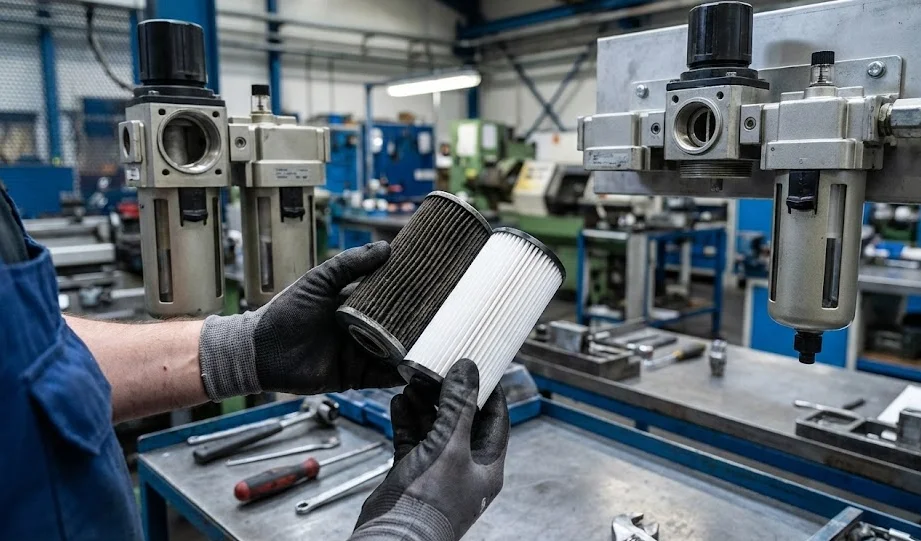
Visual inspection also plays a key role, especially in FRL units with transparent bowls. Signs that an air filter element replacement is overdue include:
- The element media appears dark brown, black or heavily stained instead of its original color.
- The bowl shows frequent or persistent condensate even after regular draining.
- Oil films or sludge are visible on the element or bowl walls, suggesting severe oil carryover.
Any evidence of physical damage—such as tears, collapsed pleats, corroded support screens or deformed seals—means the filter can no longer provide effective protection and should be replaced immediately. Relying solely on visual checks, however, can be misleading, so they should be combined with differential pressure measurements or a time-based schedule.
Recommended Air Filter Element Replacement Intervals
Time-Based Maintenance Intervals
Many plants start with a conservative time-based schedule for air filter element replacement and refine it over time. A common baseline is:
- At least once per year for general-purpose FRL filters in moderate environments.
- Every 6 months or less in very dirty, humid or oil-rich environments, or on lines serving critical equipment.
- Coalescing or high-efficiency filters may require more frequent changeouts than coarse prefilters because their finer media saturates faster.
Original equipment manufacturer (OEM) documentation often recommends specific maximum lifespans (for example, one year or two years, whichever comes first) along with maximum allowable differential pressures. Aligning filter element changes with scheduled plant shutdowns or annual overhauls minimizes disruption and helps ensure that air quality is restored to spec before production ramps up again.
Condition-Based Replacement Strategy
A more advanced approach combines time-based rules with condition monitoring. In a condition-based strategy, maintenance teams set both a maximum calendar interval and a maximum differential pressure for each filter. The element is changed whichever limit occurs first. This strategy prevents filters from being left in service long after they have become restrictive, while avoiding unnecessary replacements on lightly loaded systems.
To implement condition-based air filter element replacement, you can:
- Record initial clean filter pressure drop and track how it changes over months of operation.
- Install simple visual or electronic differential pressure indicators on filters serving critical lines.
- Analyze compressor energy data and correlate any upward trends with the condition of major filters in the network.
Over time, this data-driven approach often reveals which FRL units require more frequent attention and which could safely have their replacement interval extended, improving both reliability and cost control.
How to Replace Air Filter Elements Safely in FRL Units
Preparation and Isolation Steps
Safe and effective air filter element replacement starts with proper preparation. Before opening any FRL bowl or filter housing:
- Isolate the air supply:
Close the upstream shutoff valve feeding the FRL assembly. If available, use an integrated lockable shutoff or dump valve. - Depressurize the downstream circuit:
Vent residual pressure from the lines by operating a dump valve, actuating a downstream device, or using the manual drain on the filter bowl. - Verify zero pressure:
Check pressure gauges or carefully open a drain to confirm that no significant pressure remains before loosening the bowl. - Wear appropriate PPE:
Safety glasses and gloves are recommended, especially in oily or dirty systems where expelled condensate can be hazardous.
Documenting these steps in a standard operating procedure (SOP) ensures that technicians follow a repeatable, safe routine every time they service FRL air filters.
Replacement Procedure and Re-Start Checks
Once the system is safely isolated and depressurized, the physical air filter element replacement process typically follows these steps (always consult the specific product manual):
- Remove the bowl:
Unscrew or release the bowl from the filter body. Be prepared to catch any remaining condensate. - Extract the element:
Unscrew or pull the element from its support stem or bayonet fitting, taking care not to damage sealing surfaces. - Inspect and clean:
Wipe the inside of the bowl and body with a lint-free cloth, removing sludge, rust particles or other debris. Check O-rings and seals for damage. - Install the new element:
Fit the replacement element firmly on its stem or seat, ensuring it is properly aligned and sealed. Only use compatible elements specified for that filter model. - Reassemble the bowl:
Refit the bowl, tighten by hand and then to the manufacturer’s torque guidelines if specified. Check that any auto-drain mechanism is correctly seated. - Restore pressure gradually:
Slowly open the upstream shutoff valve and watch for leaks around the bowl and fittings. Verify that downstream pressure reaches the correct setpoint and that differential pressure across the filter is appropriate for a clean element.
Logging the date, filter location, element type and observed condition during each replacement helps build a valuable history for future optimization.
Best Practices to Maximize Air Filter Element Lifespan
Choosing the Right Filter Type and Micron Rating
The right filter choice can significantly extend the interval between air filter element replacement events without compromising air quality. Key selection points include:
- Micron rating:
Coarser filters (e.g. 40 μm) allow more dirt to pass before clogging but provide less protection to sensitive downstream devices. Finer filters (e.g. 5 μm) protect better but saturate faster. Often, a staged combination of coarse prefilter plus finer secondary filter is ideal. - Element media and construction:
Pleated media offers more surface area and longer life than simple cylindrical elements for the same housing size. Oil-resistant materials are preferred in systems with noticeable lubricant carryover. - Bowl size and drainage features:
Larger bowls store more condensate and reduce the risk of carry-over during surges. Auto-drains can minimize manual intervention and help keep elements drier.
cnzzjyt.com provides several air filter series, such as AF-BF Series air filters and LF Series large-capacity filters, enabling designers to match filter capacity and performance to the actual demand of the pneumatic system.
Integrating Filters into Preventive Maintenance Programs
To prevent air filter element issues from becoming production problems, they should be fully integrated into your preventive maintenance (PM) strategy rather than handled reactively. Practical steps include:
- Create a filter register:
List all FRL units, stand-alone filters and critical point-of-use filters, with locations, model numbers, element part numbers and typical replacement intervals. - Standardize inspection tasks:
Add filter bowl inspection, condensate draining and pressure-drop checks to weekly or monthly PM rounds, depending on system criticality. - Align with compressor maintenance:
Coordinate air filter element replacement on major distribution lines with compressor service intervals to minimize downtime and ensure consistent air quality. - Use visual management:
Apply tags or labels showing last replacement date, next due date and acceptable pressure drop range. This helps technicians make quick decisions during rounds.
By combining appropriate product selection—such as AF-BF series filters, filter-regulator combinations and upstream FRL units—with disciplined maintenance, plants can maximize air filter element lifespan without compromising downstream equipment reliability.
FAQ: Air Filter Element Replacement
Q1: How often should I replace air filter elements in FRL units?
Most general-purpose industrial systems replace elements at least once per year, with more frequent changes (every 3–6 months) in dirty or high-humidity environments. Actual intervals should be refined based on measured pressure drop, visual inspections and experience with your specific application.
Q2: Is it better to clean or replace air filter elements?
Many compressed air filter elements are designed as disposable and should be replaced rather than cleaned, because cleaning can damage the media or leave embedded contaminants behind. If the manufacturer specifies that elements are washable, follow their cleaning procedure and still monitor pressure drop closely.
Q3: What pressure drop value indicates that replacement is necessary?
Each manufacturer defines recommended limits, but a strong increase above the clean-filter baseline—often in the range of several tenths of a bar—signals that restriction is becoming excessive. When downstream pressure cannot be maintained without raising compressor setpoints, it is usually time for air filter element replacement.
Q4: Can I use a finer micron element to improve air quality without other changes?
Installing a finer element will improve particle removal but also tends to shorten service life and raise pressure drop. A better approach is to use staged filtration (coarse + fine) and verify that compressor and piping capacity can support the additional restriction.
Q5: How does delaying air filter element replacement affect operating cost?
Running with clogged filters forces compressors to work harder to maintain pressure, increasing energy consumption and accelerating wear. It also increases the risk of contamination breakthrough if elements rupture under high differential pressure. Timely replacement is almost always cheaper than the combined cost of extra energy and potential production downtime.
Related Pneumatic Products from cnzzjyt.com
- AF-BF Series Air Filter for FRL Units
- AF Series Compact Air Filter
- LF Series Large-Capacity Air Filter
- AFR/BFR Series Filter Regulator Combinations
- AW Series Filter Regulator
- FRC Series FRL Duplicate Combination
- AFC-BFC Series FRL Duplicate Combination
- AR-BR Series Air Regulator